28 mar 2013

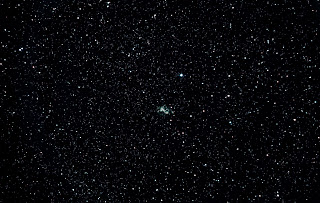
NGC 2899. Another irregular planetary nebula.


This planetary nebula is in the constellation Vela.
Is of magnitude 10. Its apparent size is 120 "x 60".
It is red and is located at 6500 light years.
This photo is the result of taking 53 frames to 50 seconds. It took 20 darks, flats and offsets.
Processed with Pshop; Pix Insight and Gimp.


26 mar 2013

A strange irregular planetary nebula.


This planetary nebula is called NGC 5189.
It is in the constellation Musca, at 24 ° of the south celestial pole.
It looks like a barred spiral galaxy. This irregular shape is the result of the gravitational action of a nearby star of the exploded star. Its aparent size is 3 minutes by 2 minutes
Were 59 frames of 1 minute exposure at ISO 1600. Were processed with Deep Sky Stacker, Photoshop and Pix Insight.


23 mar 2013

IC 2944, a nebula with Bok globules


IC 2944 is an open star cluster and emission nebula. It is the birthplace of new stars. It is in the southern constellation Centaurus. This object has a magnitude of 4.5.
Can be seen bottom left Bok globules or Thackeray globules.
The IC 2944 is at 5900 light years away.
This photo is processed with 36 lights for one minute of exposure.
The camera was a Canon 450D modified. ISO 1600. A filter UHC / LPR Celestron.
The photo was processed with Deep Sky Stacker; Pix Insight, Photoshop and Gimp.
We applied 20 flats, 20 darks and 20 offsets.
This photo is a cut in the central area of ​​the original photo.


19 mar 2013

New Eta Carina Nebula


This photograph of this magnificent nebula in the constellation Carina was acquired on March 16, 2013.
It is the result of 47 frames, 20 darks, 20 flats and 20 offsets.
We used the same telescope. We used the modified Canon 450D camera and a Celestron antipollution filter.
These are pictures taken at ISO 1600 and with an exposure of 1 minute.


A new process of a picture of the Tarantula Nebula.


With photos taken on February 12, 2013 I made this rework.
This time I used the "auto white balance" in the program Deep Sky Stacker.
Also I used "star mask" for stars.
I think this is better than the last.


6 mar 2013

Carina nebula

This nebula is a wonder of the southern sky. It is four times larger than the Orion nebula.
Also called NGC 3372 or Eta Carina Nebula.
It is about 6000/10000 light years from earth. It is an emission nebula.
This photograph was taken on February 9, 2013.
Lights are 50 "exposure at ISO 1600. Taken with a Canon 450D modified with antipollution filter. The camera was mounted on the telescope Sky Watcher 200 mm aperture.
The photos were processed with Deep Sky Stacker and Photoshop.

20 feb 2013

The Orion nebula

Also called Messier 42 or NGC 1976. I'ts in the constellation of Orion..
It is at 1270 light years from Earth. For this photo I took 184 photos of 15 "to ISO 400, with a UHF antipollution filter and a modified Canon 450D camera.
My observatory is located in a place with terrible light pollution.
Does anyone know how to eliminate the light pollution in our cities?
This photo was taken on 2012/12/12 but the process was done 2013/02/20


18 feb 2013

Old Photo - new treatment


This is a photo taken on Oct. 3, 2012. This time I processed the photo reducing the noise coming from the artificial light of the city.
This is the Lagoon Nebula.
This nebula is also called Messier 8. It is located in the constellation Sagittarius, about 5,000 light years.


1 dic 2012

A photograph of the satellites of Uranus.

This photo was taken with a Hokenn  200/1000 telescope. The camera was a Meade DSI Pro. I used the Envisage program. Do not use with the "planets" function. Use the "Deep Sky" function to see the satellites of the planet. They see the original photo, a photo cutout, a map taken from Stellarium program and a photo with arrows showing the satellites of the original photo.

25 nov 2012

Open cluster in Eta Carinae

This is a nice open cluster with some 50 stars. This cluster have a diameter of 6'. Was taken in 2012/11/24 at 03:48 AM with mi Meade DSI monochrome camera and the Envisage programe. Distance: 8400 ylights. Apparent madnitude: 4.7

3 oct 2012

This picture was taken with my Canon 450D. But now this camera is modified. We remove the IR filter. The photo is the result of 19 frames of 1 minute of exposure. ISO 1600. 20 darks, 20 flats and 20 offsets. I put a filter Celestron UHC / LPR. The photo was processed with Deep Sky Stacker and Photoshop. This is the nebula Messier 8 also called Lagoon. It is an emission nebula located in the constellation of Sagittarius. It is at a distance of 5,000 light years.

16 ago 2012

Hello! He spent a long time since the last photo. This happened because I had personal problems. Today I upload a photo of the lunar crater Copernicus. Not a good photo, but the lighting of the sun can see very well the emission of matter from the point of impact. Hope you like. It was taken on 12/04/2012 at Buenos Aires time 0h30m.

18 abr 2012

Globular cluster NGC 3201

Hey.
I share a picture of this small and sparse globular cluster in the constellation Vela. 18'de apparent size. Magnitude of 8.2.
The is located at a distance of 16,300 years Earth light
The photo was taken between 9:18:54 pm and 10:15:00 pm on April 15, 2012 at ISO 800
There are 13 lights for 150 seconds + 20 darks / flats / offsets.
Canon 450D + Hokenn 200/1000.

13 abr 2012

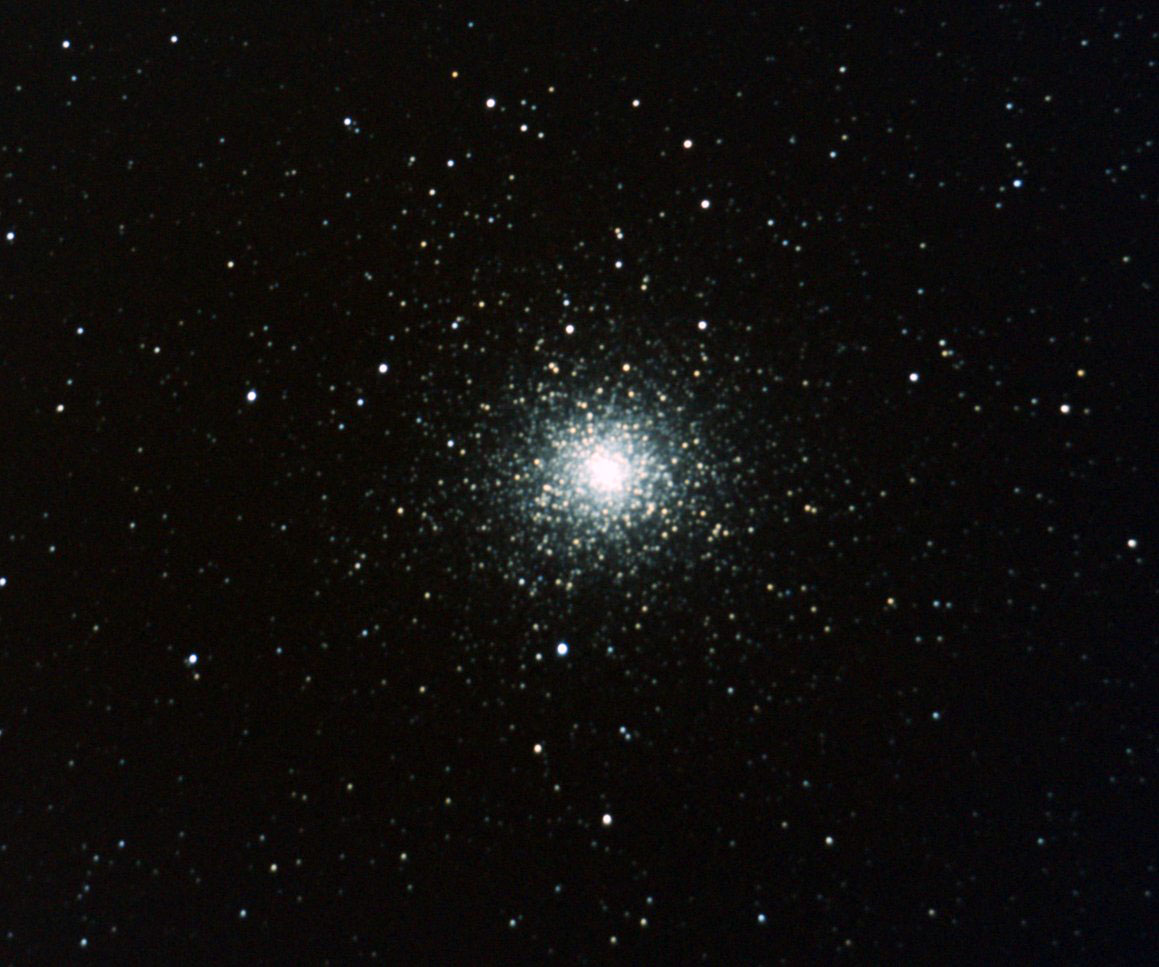
Globular cluster NGC 2808

This globular cluster is in the constellation Carina.
It is a very compact cluster with more than 1 million stars.
The distance from the earth is 31,200 years light.
Apparent magnitude: 6,20. Aparent size: 14 minutes of arc.
Distance to earth: 31200 light years.
Has over 1 million stars.

Hokenn Telescope 200/1000 + Canon EOS 450D.
47 frames + 20 darks + 20 flats + 20 offsets.
Processed with DeepSkyStacker + PixInsight + Gimp6
Captured between the 2012/04/12 at 11:11:05 PM to 2012/04/13 at 12:23:02 pm.

10 abr 2012

Photographs of the Moon and Saturn

These photos were taken on the night of Tuesday 10 April to Wednesday 11.
All photos used a Canon A470 camera and an eyepiece apochromatic with 5 mm focal longitude.
The videos were processed with VirtualDub and Registax5.


31 dic 2011

2 photographs taken with the Deep Sky Imager Pro Monochrome.


NGC 3132 is a planetary nebula in the constellation Vela, known as the South Ring Nebula.
24/12/2011 12:49:46 AM
Apparent magnitude 8. Visual size: 0 ° 00'48 ". ​​RA: 10h 07m 0.0 s. Decl -40 ° 26'00, 0"
Diameter: approx. 0.5 years light. Distance: 2000 light years.
The central star is not what drove the broadcast material. That star is much smaller and not visible in this photo.
There are 34 lights but the darks. Offset at 55. Gain: 100. Enhanced darks: 17.


NGC 2070 or 30 Doradus or Tarantula nebula.
HII nebula located in the Large Magellanic Cloud.
Central star cluster is a massive cluster called R136.
12/26/2011 3:55:26 AM
RA: 05h 38m 36.0 s. Decl: -69 ° 04'38 ".
Visual size: 0 ° 40'00 ". Mag: 8.20. Distance: 170,000 light years.
There are 51 lights with darks. Offset at 55. Gain: 100. Enhanced Darks: 17

21 dic 2011

Photographs taken with the Meade DSI Pro monochrome camera

These images retain their original size. The field photo is about 12 x 8 minutes. Are taken at the telescope focus Hokenn 200/1000.The 3 photos are the result of about 50 lights of 30 sec, with the darks. All photos are made ​​with the Envisage program.


NGC 6528: Globular cluster, beyond the spout of the teapot of Sagittarius. Seen through the dense star field of the Milky Way. On the right is on the border of a dark nebula called Baade's Window.


NGC 2362 is an open cluster located in the constellation Canis Major at a distance of 5400 light-years, centered on the star Tau Canis Majoris, which is the brightest member, and very young, with an estimated age of 4-5 million years.
The cluster contains about three dozen stars of O and B spectrum plus over 100 low-mass stars that have not yet entered the main sequence.
Given his youth, NGC 2362 has also been studied to investigate the formation of planets around sun-like stars


Sculptor Galaxy Sculptor Galaxy (also known as the silver coin, NGC 253 or Caldwell 65) is a spiral galaxy in the constellation Sculptor. Approximately 11.5 million light years away

18 nov 2011

New pictures of the moon


The craters are Piccolomini and Tiborius.


The largest craters are Catharina and Zagut.


The largest craters are Fracastorius y Piccolomini

These photos were taken on November 15, 2011. The telescope is a Hokenn 200/1000. The Canon A470 camera. Was used with a zoom x3.4. Super Plossl 10mm eyepiece. Are videos between 1500 and 2000 subs. The subs were processed with Registax for a minimum quality of 85%. Photoshop and Gimp.


A photo of Messier 42. Hokenn Telescope 200/1000. Canon 450D unmodified. 76 subs of 40 sec at ISO800. Deep Sky Stacker, Photoshop and Gimp Pixinsight. Photo taken on November 16, 2011 at 1:25

E


Photo taken on 11.14.2011 at 23:40 local time. Jupiter with Ganimedes. Ganimedes's shadow is cast on Jupiter.


Photo of Jupiter taken on 13/11/2011

Both photos were taken with a telescope and camera 200/1000 Hokenn Canon A470. The photos are the result of 1min30 sec films (about 1500 frames of which were about 250)